
Key Takeaways
- IPM eliminates the root cause of an infestation by prioritizing proactive measures like sealing entry points and removing food sources.
- It focuses on non-toxic methods and habitat changes, using targeted applications as a last line of defense.
- While it may involve more initial effort, it is more cost-effective over time because it prevents the cycle of recurring pests.
- For long-term success, the property owner should manage maintenance, while the pest control company provides specialized monitoring.
- Conventional treatments are used for immediate “knockdown” of active emergencies, while IPM serves as the long-term solution to keep them from returning.
Integrated Pest Management (IPM) is a strategic and sustainable framework for resolving pest issues in homes and businesses. By utilizing a combination of biological controls, structural modifications, and specialized treatments developed by entomologists, IPM focuses on the root causes of an infestation rather than just managing the symptoms.
Compared to traditional extermination methods, IPM offers improved safety, higher environmental standards, and more reliable long-term protection for your property assets.
How Does IPM Work?
Standard pest control is often associated with routine liquid applications and baits. However, effective pest management is much more comprehensive than a single-tactic approach. For many common pest issues, relying solely on conventional chemical treatments is often not the most efficient or effective way to achieve a permanent resolution.
The goal of Integrated Pest Management is to deliver a durable, long-term solution. To ensure success, our team follows a rigorous three-step IPM protocol:
- Scope and Identification: We identify the specific pests involved, locate their entry points, and assess the overall risk to the structure.
- Targeted Control: IPM prioritizes managing pests without jumping straight to liquid applications. Once mechanical or biological barriers are established, we use targeted treatments only as a secondary measure.
- Prevention: We eliminate the environmental factors that attract pests through non-invasive habitat modifications, exclusion work, and consistent monitoring.
Integrated Pest Management vs Conventional Pest Control: What’s the Difference?
Both IPM and traditional pest control have specific roles in a property management plan. For example, if a sudden infestation is disrupting your home life or impacting business operations, conventional pest control is the best tool for a rapid population knockdown. Once that immediate milestone is achieved, IPM is the ideal follow-up to maintain a pest-free environment.
These two methods are often used in tandem: conventional treatments solve the active emergency, while IPM is established as the follow-up to ensure pests do not return.
The following outlines how the two strategies compare:
| Integrated Pest Management (IPM) | Conventional Pest Control | |
|---|---|---|
| What’s the Main Goal? | Long-term prevention and management. | Immediate eradication of ongoing pest problem. |
| Use of pest elimination products? | As a last resort. Targeted treatments only where they’re sure to have maximum impact. | Often uses insecticides and other chemical treatments, including bait stations. |
| Environmental Impact | Low; protects beneficial insects and water quality. | Varies by treatment and pest type, but generally higher impact than IPM. |
| Sustainability | High; pests cannot develop resistance to IPM. | Low; can lead to pesticide resistance over time. |
| Health & Safety | Prioritizes minimal exposure to humans and pets. | Higher risk of exposure, but technicians take every precaution to minimize risk. |
| Recommended for Homes? | Yes | Yes |
| Recommended for Businesses? | Yes | Yes |
Does IPM Always Work?
To achieve the best results with IPM, the property owner must take an active role as a project partner. We rely on you to monitor the environment between our visits and stay on top of the daily maintenance tasks that make a building less attractive to pests.
Essential maintenance protocols include:
- Dispose of waste regularly and store it in heavy-duty, sealed containers.
- Keep basements and crawl spaces dry and well-ventilated.
- Monitor for signs of activity, such as gnaw marks or droppings, and seal entry points immediately.
- Seal cracks and holes on the building exterior, particularly around utility lines and pipes.
- Keep tree branches and shrubbery trimmed away from the structure.
- Replace any decaying exterior wood, which can act as a primary attractant for certain insects.
- Update weather-stripping and repair loose mortar around foundations and windows.
- Ensure your drainage system is moving water away from the foundation.
- Confirm that no water is standing on flat roof surfaces.
Understanding Integrated Pest Management
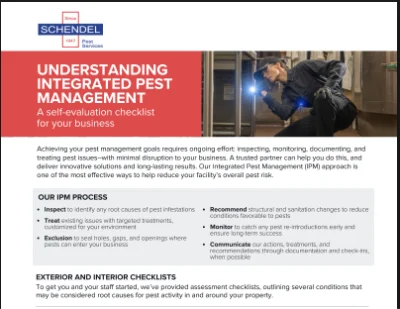
Take control of your facility's pest risk today with our Integrated Pest Management self-evaluation checklist.
Download Your CopyIs IPM for Residential or Commercial Pest Control?
Integrated Pest Management is equally effective for both residential and commercial properties. We recommend an IPM strategy for any location where recurring pests have been a persistent issue that traditional methods haven’t been able to solve.
With standard pest control, the goal is to find the pests and treat them for an instant result. With IPM, the goal is long-term results; we achieve that by fixing the root cause so the problem stays solved. This makes it a practical choice for both families and business owners.
If you are ready to implement Integrated Pest Management, the Schendel Pest Services team is ready to help. Call us today to arrange your free pest assessment.
FAQs About Integrated Pest Management
This depends on the specific pest profile. While you may see a reduction in activity within days, the goal is total removal. Because IPM addresses the source, it can take several weeks to fully disrupt the breeding cycle.
The initial inspection and structural fixes are labor-intensive and may have a higher upfront cost. However, because it prevents future infestations, it saves money over time by reducing the need for repeated emergency visits.
Most IPM plans involve quarterly or bi-monthly inspections. The focus is on monitoring—checking traps and entry points to catch a problem before it becomes a full-blown infestation.
Usually, no. Because IPM prioritizes non-chemical methods and uses targeted baits or gels rather than broad sprays, you can generally remain on-site while the technician works.
Not by itself. For an active crisis, we recommend using conventional pest control first to reduce the population immediately. Once the situation is stable, we transition to IPM to ensure they do not return.
No. This is a primary benefit of the approach. By avoiding “blanket sprays” and using pinpoint treatments, IPM protects beneficial insects and prevents chemical runoff that could harm local wildlife or pets.
While often grouped together, there are differences. Green or organic typically refers to the products themselves. IPM is the methodology of using proactive measures like blocking access and removing food sources. While it is an environmentally friendly choice, IPM may use conventional treatments in a targeted way for maximum impact.
Schedule Your Free Inspection
Residential Services


Termite Control

Mosquito Control

Bed Bug Control

Bee Control

Mole Control


Pest Control Insulation

Wasp & Hornet Control
Recent Blog Posts

Eco-Friendly Ways to Get Rid of Ants Naturally
Ants are common household invaders, and once they find food or moisture, they’re quick to bring in the rest of their colony. Even though professional pest treatments are the most…
Rat Behavior: What Every Homeowner Should Know
Rats are survivors by nature, having adapted to nearly every kind of environment over millions of years. Originating in Asia and Australia, they have spread across the world. In ,…
Trusted by over 30,000 Homes & Businesses
I just wanted to let you know how much we appreciate the courtesy always displayed when Derrick visits our office and showroom. He is polite and friendly and does his job efficiently. Today he even asked if he might assist us in tuning in our staticy radio we have at our front door. It took him less than a minute to see that we had wires miswired and corrected it. It was a small effort but greatly appreciated. He is a wonderful asset to your staff.
Lynn Utt
Furniture Options




Schedule Your Free Inspection
What Is Integrated Pest Management (IPM) in Kansas, Missouri and Arizona?
Serving Kansas, Missouri and Arizona


